Book a car from local rental companies in Cape Town through the Localrent platform and explore the Cape Peninsula, Winelands, and Garden Route at your own pace.

Localrent lists rental offers from local companies operating in Cape Town and across South Africa. You search and book through the Localrent widget above, pay the booking advance online, and the rental company sends a voucher with all terms and the final pick-up address. The rental agreement is signed directly with the local provider named in your voucher.
Pick-up formats in Cape Town vary by company. Some deliver to Cape Town International Airport - located 20 km from the city centre on the N2 - where you meet the supplier outside the terminal or in the short-term car park. Others offer delivery to your hotel or accommodation in the city bowl, Atlantic Seaboard, or Camps Bay. A few operate from fixed offices in suburbs like Century City or Foreshore. The voucher confirms the exact meeting point, contact number, and any instructions for after-hours collection.
If you choose airport delivery, the rental company typically meets you in the arrivals hall holding a sign with your name, then walks you to the vehicle parked nearby. Hotel delivery means the car arrives at your specified address within the agreed time window. Office pick-up involves taking an Uber or shuttle to the company's location, which can save on delivery fees but adds a transfer step.
Check the voucher carefully for the pick-up format before you land. Some local companies in Cape Town require a WhatsApp message on arrival, while others prefer a phone call. The remaining balance is paid to the rental company at pick-up as stated in the voucher, usually by card or cash depending on the supplier's policy.
Cape Town International 20 km northeast on the N2, 25 minutes without traffic.
Left-hand traffic. Right-hand-drive vehicles. Overtaking on the right.
Treat dark traffic lights as four-way stops during power cuts. Yield in turn.
Secure parking strongly advised. Use guarded lots at malls and hotels, avoid on-street overnight.
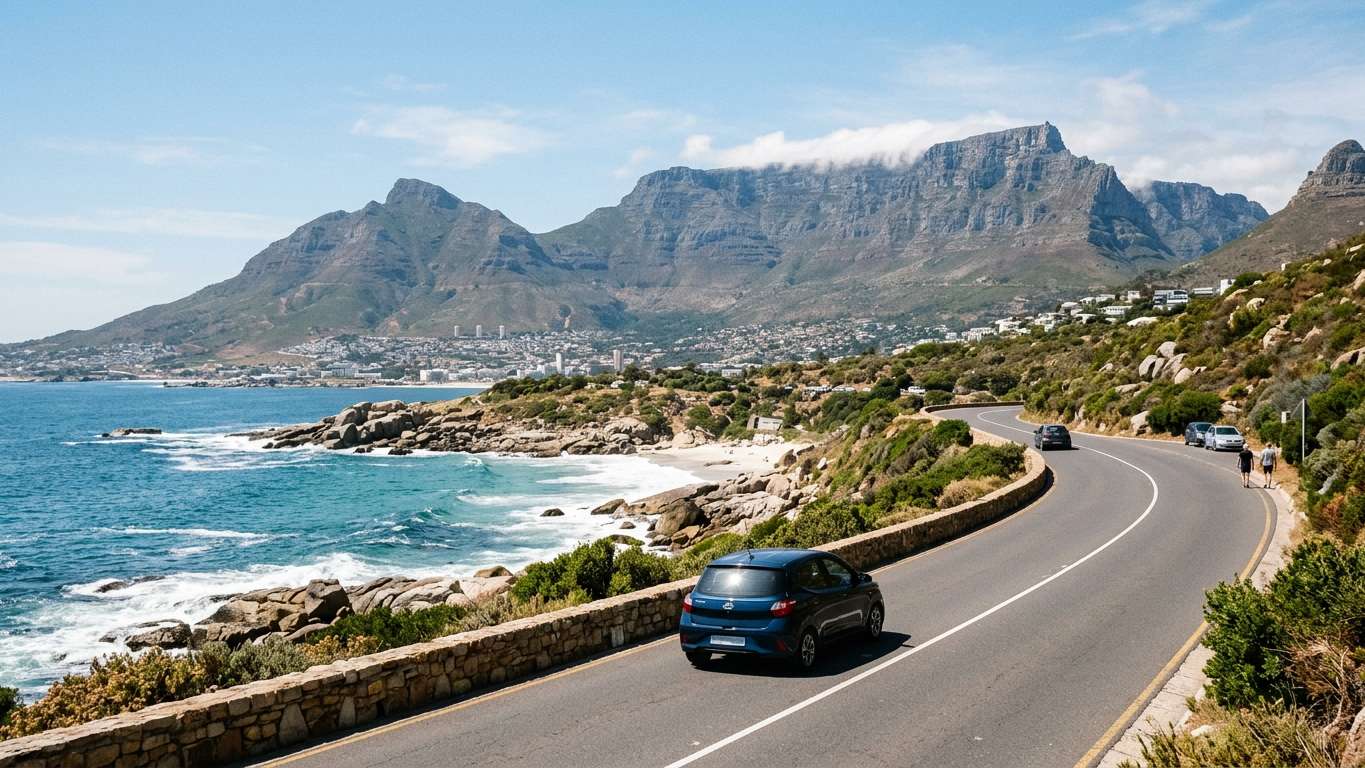
Chapmans Peak Drive charges a toll for the coastal route between Hout Bay and Noordhoek.
Enter dates and pick-up location in the Localrent widget. The platform shows cars from local companies with availability in Cape Town.
Select a car and complete the booking advance payment online. This secures your reservation through Localrent's system.
The rental company emails a voucher with pick-up details, terms, insurance coverage, and the remaining amount due at collection.
Meet the supplier at the address in the voucher, sign the rental agreement, pay the balance, and drive away.
Local companies listed on Localrent offer a range of vehicle types suited to Cape Town's mix of city streets, mountain passes, and coastal roads. The table below shows typical classes, sample models, best-use scenarios, and practical notes.
| Class | Sample Models | Suits | Notes |
|---|---|---|---|
| Economy | Hyundai i10, Kia Picanto | City centre, solo or couple, short trips to Stellenbosch | Manual gearbox common, limited boot space |
| Compact | VW Polo, Toyota Corolla Quest | City and Winelands, small families, Airport run | Good fuel economy, easier parking than sedans |
| SUV | Nissan X-Trail, Toyota Fortuner | Cape Point, Chapmans Peak, Garden Route trips | Higher ground clearance, more luggage capacity |
| Minivan | Hyundai H1, Toyota Quantum | Groups of 6-8, surf trips, wine tours | Manual often cheaper, check seating layout |
| 4x4 | Toyota Hilux, Ford Ranger | Overland to Namaqualand, gravel roads in Cederberg | Manual common, higher rental cost |
Automatic transmission is available across all classes but costs more than manual. If you plan to drive Chapmans Peak or up to Signal Hill, an SUV or larger sedan handles the gradients and wind more comfortably than an economy hatchback.
Cape Town's summer - December to February - brings temperatures of 25-30 Celsius and long daylight hours. It's peak season for beaches and outdoor routes. The Localrent offers in Cape Town make day trips and longer drives straightforward. Below are popular destinations with approximate distances, drive times, and road notes.
| Destination | Distance | Time | Road Notes |
|---|---|---|---|
| Boulders Beach (Penguins) | 45 km | 45 min | M3 to Muizenberg then M4, coastal scenic route |
| Cape Point | 70 km | 1 h | M3 to M6, steep descent to car park, paid entry |
| Stellenbosch | 50 km | 45 min | N2 to R310, winelands, many tasting rooms |
| Franschhoek | 75 km | 1 h 10 min | Via Stellenbosch or over Helshoogte Pass, narrow roads |
| Hermanus | 120 km | 1 h 40 min | N2 then R43, cliff-path walks, whale season Sep-Nov |
| Knysna (Garden Route) | 490 km | 5 h | N2 all the way, overnight stop recommended |
Chapmans Peak Drive between Hout Bay and Noordhoek is a toll road with dramatic cliff views - worth the stop for photos. The Cape Winelands around Stellenbosch and Franschhoek are 45 minutes inland; many visitors do a full-day loop hitting three or four estates. For the Garden Route, budget two to three days and book accommodation in Knysna or Plettenberg Bay.
Some local companies on Localrent offer no-deposit car hire in Cape Town, meaning you pay no security hold at pick-up. Others require a deposit hold on your card, released after the car is returned undamaged. The availability and amount depend on the specific supplier and the insurance package in your voucher.
The no-deposit guide explains how this works across the platform. In Cape Town, providers that waive the deposit typically include full coverage with no excess in the rental rate. Check the voucher for the deposit line - if it says zero, you won't need to authorize any hold. If a deposit is listed, bring a credit card with enough available limit.
Insurance terms and coverage details are always stated in the voucher. Don't rely on verbal promises at the desk. If you want to change the insurance level after booking, contact the rental company directly using the details in the voucher before pick-up.
Every rental company in South Africa requires a valid driving licence, passport, and the payment card used for the booking advance (or another card for the balance). If your licence is not in English, bring an International Driving Permit alongside the original.
South African law accepts IDP formats issued under the 1949 Geneva or 1968 Vienna conventions. Some local suppliers are strict about the English-language requirement, so carry the IDP even if your home licence includes a photo. Photocopies are not sufficient - inspectors and rental desks want to see the physical card.
Bring a printed or mobile copy of the Localrent voucher. The rental company will cross-check your name, dates, and pick-up location. A credit card in the driver's name is needed for any deposit hold or additional charges like extra drivers, GPS, or child seats. Debit cards are accepted by some local firms but not all, so confirm in the voucher if unsure.
"Booked a Polo through Localrent for two weeks in January 2026. The company delivered to our Camps Bay hotel on time, car was clean and half-tank as stated. Returned at the airport without fuss. Simple process."
"Used Localrent to rent an SUV for a Garden Route trip in February 2026. Pick-up at CPT airport was smooth, voucher had exact instructions. No deposit hold because we took full cover. Would use again."
"Rented a Fortuner for a family trip to Hermanus and Stellenbosch in December 2025. Local company was professional, car had low mileage. Localrent booking system was straightforward, advance payment confirmed instantly."
One-way rentals between Cape Town and Johannesburg are possible with some local companies listed on Localrent, but expect a significant one-way fee because the distance is over 1400 km. Enter both locations in the widget to see which suppliers allow the drop-off and the extra charge. Most travellers find it more economical to book separate rentals in each city.
No. The N2 from Cape Town to Knysna and beyond is fully paved and maintained. A standard sedan or compact SUV is perfectly adequate. Reserve a 4x4 only if you plan gravel detours into the Cederberg or Baviaanskloof, which require high clearance and off-road capability.
During scheduled power cuts, traffic lights go dark. Treat every unlit intersection as a four-way stop: come to a complete halt, yield in turn to the car that arrived first, then proceed. Major highways like the N1 and N2 usually have backup generators, but suburban streets do not. Drive cautiously at night during outages.
Street parking overnight is not recommended. Use secure hotel parking, guarded shopping-centre lots, or private garages. Car break-ins do happen in the city bowl and some suburbs. Most local rental companies advise against leaving luggage visible in the car even during the day.
Cross-border travel depends on the specific rental company and the terms in your voucher. Many local suppliers do not permit cars registered in South Africa to leave the country without written permission and additional insurance. Contact the company via the voucher details before your trip if you want to drive into Lesotho, Namibia, or Botswana.
Most local companies on Localrent use a full-to-full policy: you collect the car with a full tank and return it full. A few offer half-to-half or charge a flat refuelling fee. The voucher states the exact policy. Keep your last fuel receipt in case the supplier asks for proof at drop-off.
Cape Town traffic drives on the left. Overtaking happens on the right lane. Speed limits are 60 km/h in residential areas, 80-100 km/h on main roads, and 120 km/h on highways like the N1 and N2. Fixed speed cameras are common on the N2 approaching the airport and along the M3 toward Muizenberg.
Paid parking is enforced in the city bowl, V&A Waterfront, and Camps Bay. Look for official parking attendants wearing vests; informal attendants also operate and expect a small tip when you return. Secure parking garages at malls and hotels charge hourly or daily rates - use them if you're leaving the car for more than an hour.
Minibus taxis stop frequently and change lanes without signalling. Give them space and don't assume they'll follow standard rules. Pedestrians cross mid-block in townships and some suburbs, so keep your speed moderate in built-up areas.
Fuel stations are full-service: an attendant pumps and can check oil or water. Tipping 5-10 Rand is customary. Most accept card payment directly at the pump terminal. Along the Garden Route, stations are spaced 50-80 km apart, so top up when you see one rather than waiting until the tank is nearly empty.
If you're driving up Table Mountain on Tafelberg Road or around Chapmans Peak, watch for cyclists and motorbikes, especially on weekends. The roads are narrow with steep drops and limited barriers. Wind can gust suddenly on the mountain passes, so grip the wheel firmly and reduce speed in high-wind warnings.
Ready to explore Cape Town and the Western Cape? Use the Localrent widget above to compare vehicle hire offers from local companies in South Africa. Book your car now and start planning day trips to the Winelands, Cape Point, and beyond.